
CCTV survey: $300–$750
Stands alone and is credited against the works by most operators. Without it nobody can price a liner honestly.
Relining turns a recurring drainage problem into a finished one. The joints that roots come through are sealed along the whole run, so there is no way back in, and nothing above the pipe gets disturbed to do it.
Relining is a structural repair, not a cleaning method, and the distinction matters when you are comparing quotes. Jetting restores flow through a pipe that is still cracked. A liner restores the pipe.
That also means it is not always the answer. It cannot correct a run that has sagged or lost its fall, and it has nothing to line against where a section has collapsed. A camera survey separates those cases in about an hour, and the answer changes the cost by a multiple.
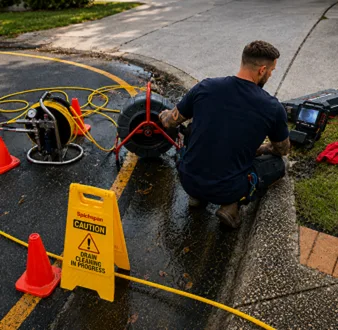
Water tracks along beams and slab falls, so the lot reporting the damage is often nowhere near the lot with the fault. Opening ceilings on a guess is how a small repair becomes three angry owners.
Camera and non-destructive location come first for exactly that reason. Once the defect is located and measured from a known point, the repair is a defined job and the liner goes in without exploratory demolition.
The eateries and takeaways along the Beamish Street strip send fats and oils into the sewer, where they harden and choke lines. We jet them clean and keep them clear.
For a shop, café or clinic the real cost of a drainage repair is rarely the invoice. It is the days the doors do not open, and an excavation through a floor or a car park is measured in days.
A liner is installed from an existing access point and cures in hours, which is why commercial work is so often scheduled overnight or across a single closed day. The trading interruption is usually the deciding factor, not the price per metre.
Where the water table sits close to the pipe, every open joint is an entry point. The line runs fuller than it should year-round, silt comes in with the water, and the system behaves as though it is undersized when it is simply leaking inward.
Low-lying ground toward the Cooks River can flood when stormwater pits and lines block in heavy rain. We clear them and restore proper drainage fast.
Sealing the run changes that immediately, and it is one of the clearest before-and-after results relining produces. It is also the case most often missed, because nothing looks broken from the surface.
Once is weather. Twice is a defect, and the second event is the point at which paying for a camera saves money rather than costing it.
What we are looking for is specific: a belly holding water, a joint that has opened, a section crushed by a vehicle crossing. Each has a different answer, and only one of them is relining. Knowing which you have is worth more than another clear.
Campsie’s many unit blocks share drainage lines, so a single blockage affects several dwellings, it needs a camera to diagnose and the right access to clear.
In a strata building the line between lot property and common property decides who pays, and it is worth settling before a quote rather than after. A branch serving your lot alone is generally yours; the stack it joins and anything in common property generally is not.
Relining changes the arithmetic here because it is usually cheaper than the alternative for a shared line, and because it can be done without opening ceilings in the lots below the fault. That tends to make the approval conversation shorter.
It is not a universal fix and anyone presenting it as one is selling rather than advising. A liner follows the shape of the host pipe, so it cannot correct a run that has lost its fall or sagged into a belly. A collapsed section has nothing to line against. A pipe crushed badly out of round has to be replaced.
In those cases the right answer is excavation, and we would rather quote that and be trusted than reline something that will disappoint you in two years.
A short patch, sometimes called a junction repair, seals one defect and is the proportionate answer when the rest of the run is sound and the ground is stable.
A full-length liner is right when the camera shows the same failure repeating along the run, which on an old clay line it usually does. Paying for a patch on a line with twenty tired joints is how people end up paying twice.
Stands alone and is credited against the works by most operators. Without it nobody can price a liner honestly.
The usual Sydney range for domestic sewer. Access and junction reinstatement are normally quoted separately.
One defect in an otherwise sound run. The proportionate answer on stable ground, and the wrong answer on a line with twenty tired joints.
Where the camera shows the same failure repeating along the length. Ends the problem rather than relocating it.
The honest comparison. Cheaper on an open lawn, rarely cheaper under a driveway, paving or a building.
These are market ranges, not our price. Nothing is quoted before the survey, and nothing starts before you agree it. Figures here are indicative of the 2026 Sydney market rather than a quote from us, you get your own number as a fixed price before any work starts.

A CCTV survey establishes the material, the diameter, where the defects are and how far they sit from the access. You see the footage, and it is what the quote is built from.
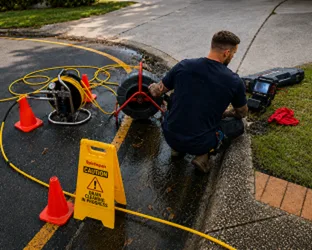
Patch or full length, and occasionally excavation instead. We will tell you when digging is the better answer even though it is the bigger quote.
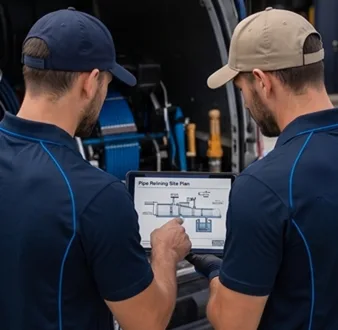
The run is jetted so the liner bonds to pipe rather than debris, the liner is installed through the existing access, and it cures in place. Most domestic jobs are a single day.

Every branch the liner passed is reopened from inside, then the run is cameraed again so you can see it is continuous and the junctions are clear.
Describe what the drain is doing and how often. We will tell you whether it sounds structural or whether a clean and a maintenance interval is the honest answer.
Cost, lifespan, method, and the cases where a liner is the wrong answer.

Phone is quickest. The form reaches the crew covering Campsie, and the first step is always the survey.

Leave your details and our local Campsie team will call you back fast.